

Bad Ideas
Part Zero: Of Brimstone & Blood

In 1971, there was an explosion in Woodbine, Georgia. Not the proverbial kind. I’m from Woodbine, and I can assure you no such thing has ever occurred. I mean the kind of explosion with fire.
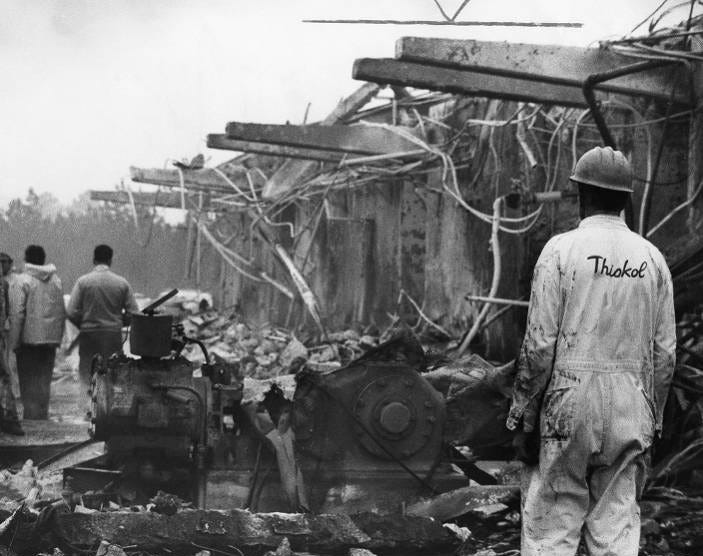
Twelve miles away, the local fire chief was alerted of the unfolding disaster by an earthquake. Homes within that range had their window panes blown out. The sound would carry as far as Jacksonville, Florida, forty miles away. It’s a good thing too, as their medical facilities were going to be needed.
When the fires started, no one was too concerned. Thiokol creates fires by design. Thiokol began in 1929 as America’s first rubber company, a peculiar appendage off of Morton Salt. Providing synthetic polymers for use in jet propulsion, Thiokol was front-and-center for the global arms race that would ensue following World War II. “Thiokol” is a portmanteau of “theío” and “kólla”, respective Greek for “sulfur” and “glue”.
The Woodbine plant, opened in 1964, started with solid propellant for NASA. Come the space agency’s sudden pivot to liquid propellants, Thiokol would turn their sights instead toward the ensuing war in Vietnam via a contract to create 754,000 tripflares for the United States Army.
Tripflares are not designed to be lethal — at least, not directly. Their purpose is to illuminate the area of a breaching assailant, alerting the gunners who laid the trap. The illumination is created by magnesium, an element known for creating bright white light when it burns. Sodium nitrate struck by a similar pin to that used in a hand grenade provides the catalyst for combustion, triggered by a tripwire.
This volatile combination of materials was not easy to work with. Fires on the factory floor were so common that many workers had grown accustomed to evacuating the ill-fated building while a maintenance team doused the fires. The employees would wait outside, returning to work once stability was reclaimed.
None of them should have been anywhere near that building.
In October of 1970 — four months prior to the explosion — experimentation within the Army’s Picatinny Arsenal had shown that the particular blend of magnesium and sodium* nitrate being used in tripflares should be reclassed from merely a combustible to a much more-regulated explosive. The researchers at Picatinny notified the Department of Defense of their discovery, prompting the change in classification. Nobody at the Department of Defense relayed this change to Thiokol.
Three months later, a Department of Defense inspector paid a visit to the Woodbine plant. The inspector reported no issues.
In the weeks leading up to the explosion, work was becoming tense. The contract had sunk into unprofitability, a million dollars in the red1. The spontaneous combustion of the materials seemed to be happening more frequently, regularly delaying work. Miss Waye, who claimed to have witnessed the fire begin at her station, described the flames as seeming to emerge from nothing, likely catalyzed by a spark too small to see. From there, the flames hopped from station-to-station, the assembly line of magnesium and sodium nitrate discs igniting like a giant fuse.
Protocol began. Business as usual, the staff filed outside. A maintenance worker — Mister Aretz — grabbed the water hose they kept around for exactly this type of problem.
The hose was not working. Worse yet, the fire was rapidly moving towards the store room, where more than fifty thousand flares — and four more tons of explosive material — awaited.
As Mr. Aretz fled for his life through the door of Building M-132, Hell followed at his heels.
Awaking across the street from what used to be his workplace, little grace would be found in Mr. Aretz’s miraculous survival. His right arm was reduced to bone by the burning magnesium. The other side of his body suffered greatly from the concussive blast, his left eardrum and leg shattered.
Those less fortunate were obliterated on the spot — twenty-three people in the immediate, and more to come. Many more lived, but now found themselves ablaze and missing limbs. A survivor, Miss Cobb, only twenty-two-years-old, was burning alive, unable to find a place to collapse that wasn’t scalding hot metal or the entrails of her peers. The road bubbled like tar. A man was melted into a metal fence. More entrails hung from trees hundreds of feet away, the towering South Georgia pines now desecrated with the blood of their inhabitants.
Every hospital and ambulance for miles around was tapped into the emergency, planes and helicopters being leveraged to get the wounded help as fast as possible. The racial segregation typical to these facilities at the time was, in a needed glimmer of humanity, temporarily put aside to help the almost-entirely black victims.
Unsurprisingly, the Thiokol plant was forced to close. Surprisingly, it only closed for six months. The Vietnam War still had a few years left on it, and those munitions weren’t going to make themselves. Luckily for Thiokol, Georgia law greatly limits the liability of corporations, making it an attractive place for those who can’t afford the cancerous, profit-draining oversight that other states would demand. Hiding behind workers compensation payouts, Thiokol was able to avoid litigation over the dangerous environment their employees were in. Instead, the blame was veered towards the U.S. Government, who certainly played a role in the disaster by the failure to communicate and enforce the changing standards required of the holder of a defense contract. No sufficient explanation was ever given for the break in communication, but that did not stop the U.S. Government from fighting tooth-and-nail against the suit for seventeen years after.
The Occupational Safety and Health Administration would open its doors only two months later, its policies inked in the blood of Thiokols’ workers. When production resumed, so did their jobs. Of the sixty mostly-female, mostly-black employees working in Building M-132, the majority made at least $18 an hour.2 Where else was a black woman with no college degree going to make that kind of money?
In 1986, there was an explosion forty-six thousand feet above the Atlantic Ocean. The rubber O-rings that maintained the seal of the Space Shuttle Challenger’s Solid Rocket Boosters had grown brittle in a cold-snap uncharacteristic of the Florida coast. Just over a minute after the shuttle launched, the O-rings gave. The burning fuel escaped the boosters and married with the liquid hydrogen fuel tank mounted underneath the shuttle. The rest is grim history, the seven crew members included. One of them was a school teacher, riding along via the efforts of the Teacher in Space Project. The countless schools that had tuned into the broadcast for a dose of inspiration for their pupils now found themselves with a terrible ordeal to explain to the shocked children.
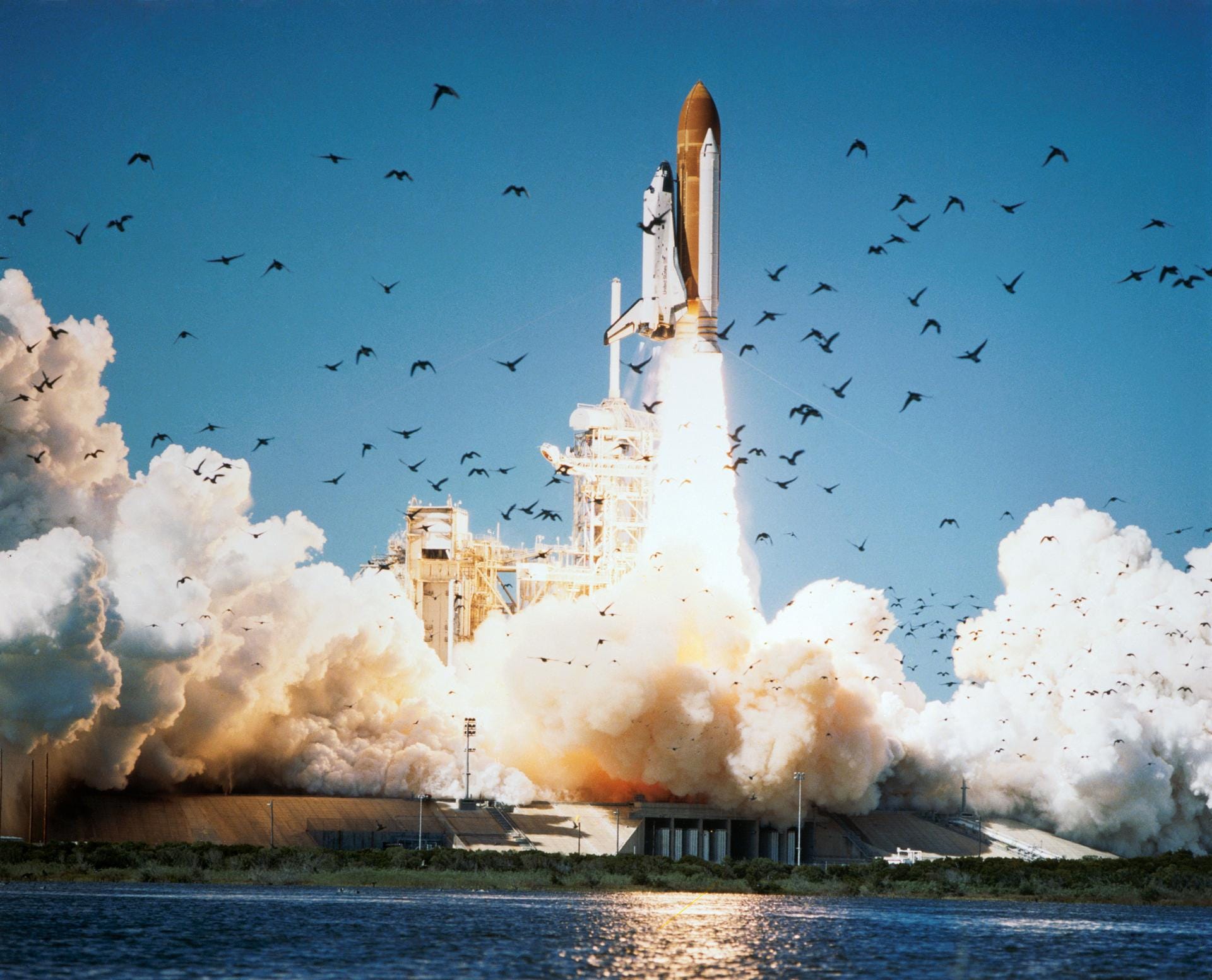
As time would go on, damning details would emerge surrounding the national catastrophe. It would end up being that warnings were given prior to the launch, multiple engineers who worked on the shuttle having felt uncertain about the stability of the design. Deadlines prevailed over safety, and the ill-fated launch that killed seven in the plain view of millions became a public relations disaster for the U.S. Government, NASA, and the contractor who created the Solid Rocket Boosters with the faulty O-Rings: a company called Morton Thiokol.
Sources
Albert Scardino, New York Times, July 20th, 1986, Sec. 3, pg. 1
Jessie-Lynn Kerr, Florida Times Union, October 18th, 2010
Lauri Holton, The Fernandina Observer, May 17th, 2025
The Thiokol Memorial Museum Website
Georgia State University, on behalf of the Atlanta Journal Constitution
~$8 million, Feb 2026
~$147 an hour, Feb 2026